
10/11/2026
Un garrot placé haut, mais pas trop sur les effets de protection quand même ?
Arterial tourniquet considerations within public order medicine: effectiveness over public order personal protective equipment
Brayford-Harris S et Al. JHTAM, 2026, ahead of print
Introduction Control of life-threatening extremity haemorrhage is a core policing skill, with arterial tourniquets widely adopted across UK services. Current guidance may not account for specific challenges posed by public order personal protective equipment (POPPE). This study evaluated the effectiveness of Combat Application Tourniquets (CAT Gen 7) applied over and around POPPE to inform evidence-based Public Order Medicine guidance.
Methods A prospective observational study was conducted during public order training using volunteer police officers. Tourniquets were applied at predefined sites over and adjacent to POPPE. Effectiveness was assessed by cessation of distal pulses (radial or posterior tibial) using manual palpation, with Doppler ultrasound confirmation in a subset. Three cohorts were used: a control group assessed by manual palpation and ultrasound across dress states, a larger volume cohort assessed manually and an index cohort assessed by both methods.
Results Fifty-four officers were enrolled. Upper-limb tourniquets were highly effective across all configurations (95–100% success). Ineffective applications were associated with smaller limb diameters and poorly sized PPE.
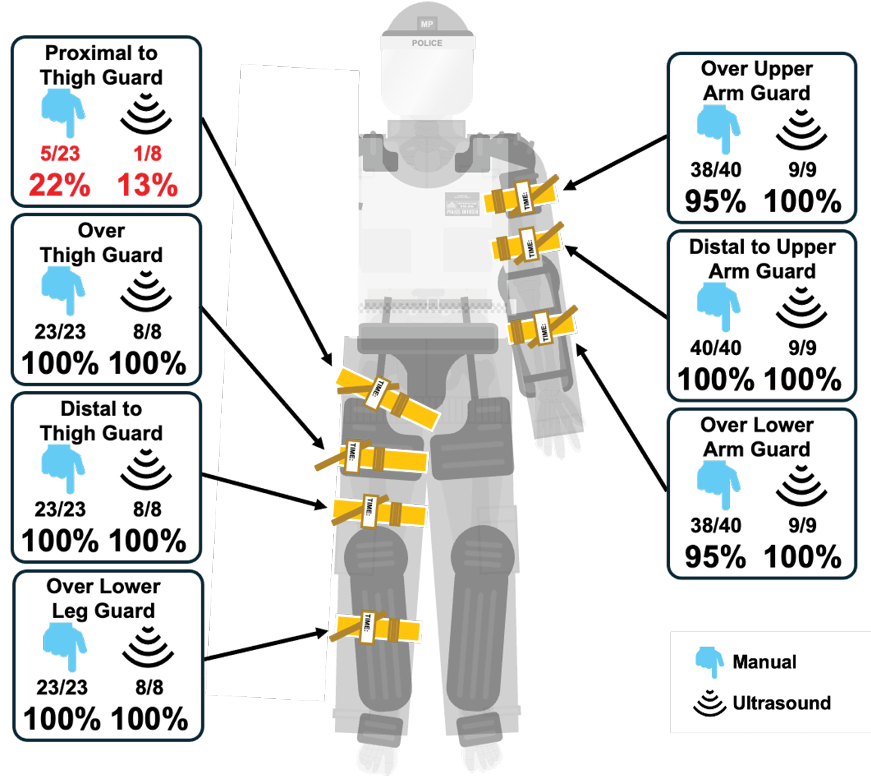
Tourniquets placed proximal to the thigh guard achieved arterial occlusion in only 22% of cases and often left insufficient space for a second device. In contrast, applications directly over the thigh guard, distal to it, and over lower-leg guards achieved 100% effectiveness. Manual pulse assessment demonstrated concordance with ultrasound-confirmed arterial occlusion.
Conclusion PPE may significantly influence tourniquet effectiveness, particularly in lower limb injuries where conventional guidance appears unreliable. PO-specific guidance should prioritise PPE removal where feasible, pragmatic placement over PPE when necessary, and early evacuation and reassessment.
Les commentaires sont fermés.